
By Seth Mandel
“Whanne he cam and was nyȝ þe hous, he herde a symphonie and oþer noise of mynstraleye.”
In modern-day English, the sentence above—written in fourteenth-century Middle English—means: “When he got close to the house, he heard a band and chorus.” About 400 years earlier, in Old English, the same sentence would have appeared as follows: “þā hē þām hūse genēalæhte, hē gehȳrde þone sweg and þæt weryd.”
One of the first rules one learns in historical linguistics is that all spoken languages are in a constant state of change; only the rapidity and significance of the changes vary. Indeed, everything in a language changes: the sounds, the morphology (word forms), the syntax (how words are put together to form a phrase) and even the intonation. Native speakers are aware of the different dialects of their own language. When a Brit talks about the “boot of the lorry” (the trunk of the truck), many Americans will have no idea what he means, even if they are able to understand the pronunciation.
This principle has several corollaries. One is that the more time passes, the more difficult it is to understand the older forms of a particular language. Another is that one language, whose speakers become separated from one another, will diverge, first into two dialects, and with time, into different languages. Spoken Latin diverged over time into many separate languages, of which Portuguese, Spanish, French, Italian and Romanian survived.
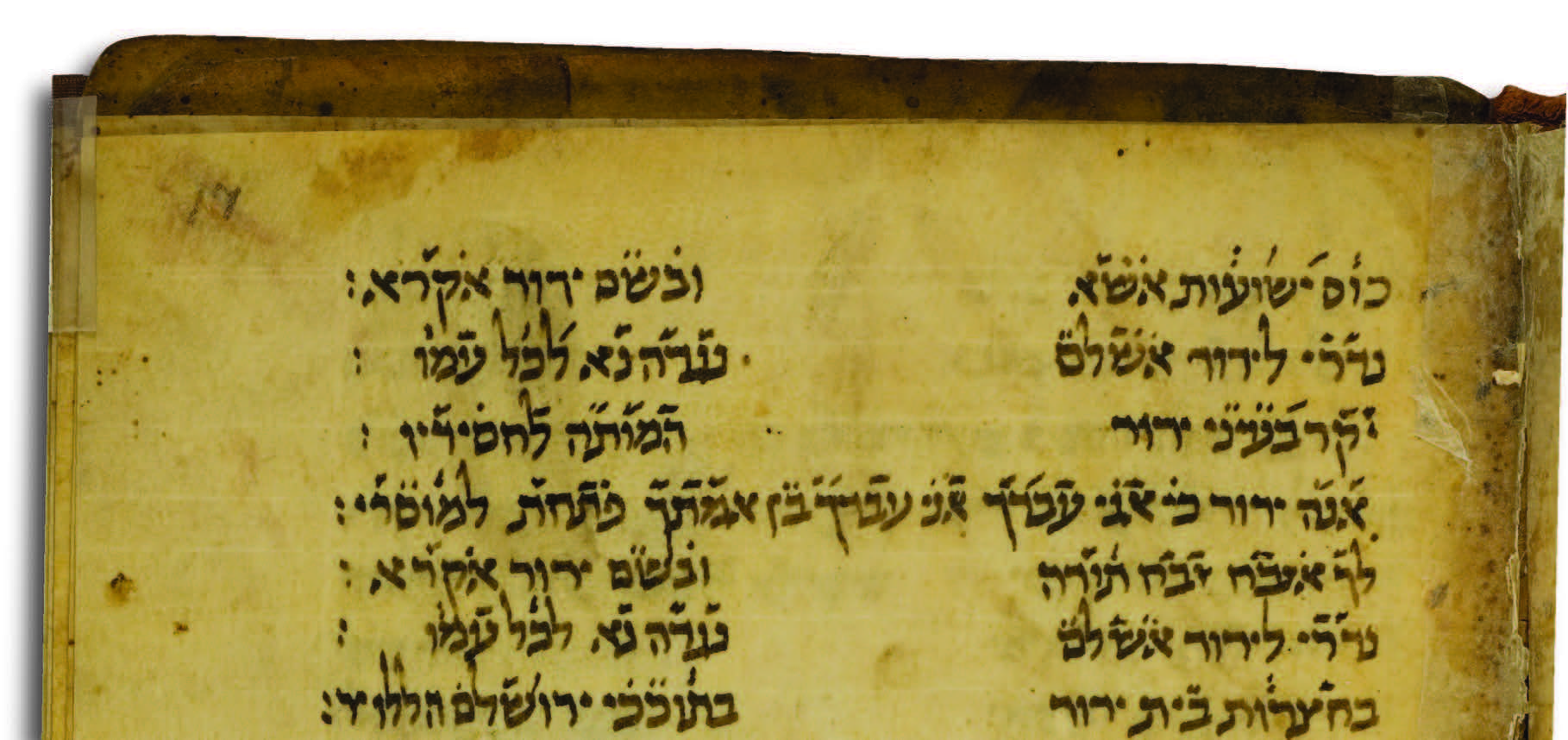
Psalm 116, copied in a twelfth- or thirteenth-century Oriental (possibly Yemenite) square hand with Babylonian supralinear vocalization.
Courtesy of The Library of the Jewish Theological Seminary, MS L508, p. 17r.
Please note that the image has been digitally altered to avoid shaimos.
While we would all like to think that we read the Torah the same way our ancestors did three or four thousand years ago, the likelihood is that we don’t. As with other languages, Hebrew changed over time. Even in the time of the Shoftim, we find that members of different tribes pronounced Hebrew differently, as the story in Shoftim 12:5 illustrates. Today, three main traditional pronunciation systems of Hebrew have survived and are used in synagogues around the globe: Ashkenazic, Sepharadic and Teimani. (The Samaritan community also preserves its own Hebrew pronunciation, which differs greatly from the Jewish traditions.)
Since numerous and significant differences exist between the three traditional systems, the obvious question is: which pronunciation system adheres most closely to tradition? In other words, which is more “correct”?
This question has no simple answer. Unfortunately, there are no YouTube videos or vinyl recordings illustrating how Avraham Avinu or Moshe Rabbeinu spoke. No one can prove that one pronunciation system more accurately reflects how the Jews in Eretz Yisrael spoke thousands of years ago. We have only written evidence. Yet written records do not record the pronunciation of words (how would one know how to pronounce “laugh” correctly from written evidence alone?).
Unfortunately, there are no YouTube videos or vinyl recordings illustrating how Avraham Avinu or Moshe Rabbeinu spoke.
Hebrew uses the original alphabet, which was invented for Hebrew or a close cousin to it. As with other Semitic languages, only the consonants were written down (no vowels). Around 700 ce, various systems for writing vowels were developed for Semitic languages, with each language developing distinct vowel symbols. Thus, despite the fact that Hebrew, Aramaic, Arabic and Amharic all share the same consonants—of course, the forms of the letters change over time, so nowadays the Arabic alphabet looks different than the Hebrew alphabet—they all have very different symbols representing vowels.
Obviously, one cannot discuss Hebrew pronunciation without first discussing Hebrew vowels. What most people don’t realize is that at least three different notation systems for denoting vowels (vowel symbols or nekudos) were invented for Hebrew, each in a different center of Jewish society. In manuscripts, one finds evidence of the “Babylonian vocalization” (developed in Bavel), the “Palestinian vocalization” (developed in most of Israel) and the “Tiberian vocalization” (developed in Tiberias, a center of Biblical scholarship at that time). The systems all came into being at around the same time. The Tiberian notation (which later was universally accepted) has seven different vowel symbols—the nekudos we are familiar with. The Babylonian vocalization has six vowels and the Palestinian has five. The traditional Sepharadic pronunciation most closely corresponds to the Palestinian notation, as it does not distinguish between the pasach and the kamatz. Nor does it distinguish between the segol and the tzere. Similarly, it is clear that the traditional Teimani pronunciation is descended from the Babylonian vowel notation system, since it uses only six vowel sounds. Most fascinating, until recently, Teimani scribes used the Babylonian nekudos. It is important to note that although the written vowels came about in 700 ce, they reflect a much older oral tradition.
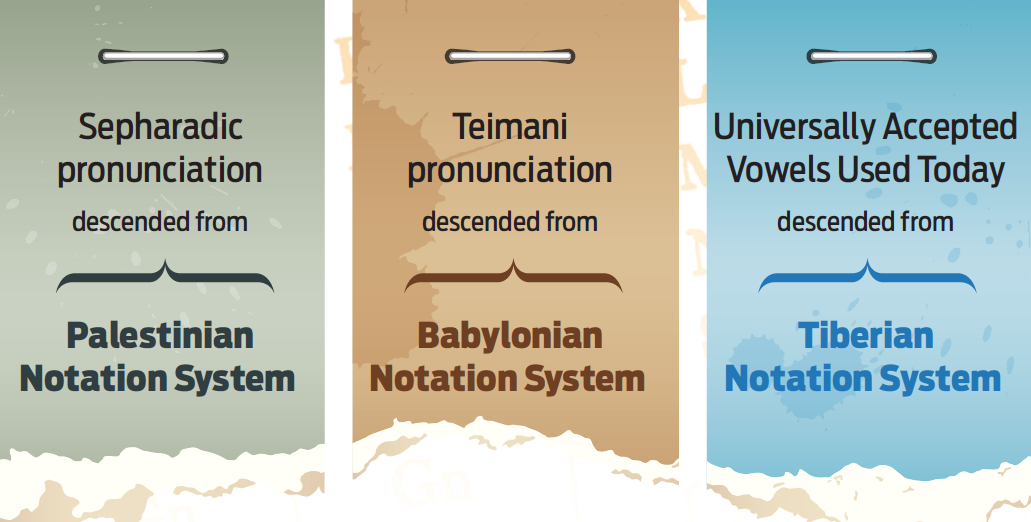
Why is the Tiberian notation system the only one still in use today? Because it was used in the Tiberian Masorah, which was considered the most authoritative. Thus, all Chumashim today adhere to the Tiberian system and feature the nekudos we are all familiar with.
Interestingly, Jews universally adopted the Tiberian nekudos, even though, for most groups, the vowel system did not correspond to their traditional pronunciation at all. Today, many Israeli children do not understand why there are two vowel signs, kamatz and pasach, when they are pronounced identically.
Among Jews who use the traditional Ashkenazic pronunciation, there are dialectal variations. Considerable differences in pronunciation exist among those from Germany, Galicia (Poland), Hungary and Lithuania. The most obvious differences involve the cholam: the German pronunciation is au (sounds like “ow” as in “cow”); the Galician and Hungarian pronunciation is oi (sounds like “oy” as in “toy”); and the Lithuanian pronunciation is ei (sounds like “ay” as in “lake”). Within the Sepharadic groups, Iraqi pronunciation differs significantly from Moroccan, and both differ greatly from the pronunciation of Sepharadim from Amsterdam. Even within the Teimanim, there are some groups who pronounce the cholam like the tzere (as the Litvish pronunciation does).
Traditions differ with regard to the pronunciation not only of vowels but of consonants as well. Rabbi Jack Abramowitz, in his article in this issue, “The Taf Guys,” is correct in stating that the Sepharadic pronunciation does not distinguish between the taf and saf. Traditional Sepharadic pronunciation (as opposed to Modern Israeli pronunciation) also does not distinguish between the beis and veis. Nor do Ashkenazim distinguish between saf and samech. Even the Teimani pronunciation, which distinguishes between all of these consonants, may have undergone changes through the years.
The Sages in the Gemara speak about errors in pronunciation. In Megillah 24b, Chazal state that residents of Beit She’an and Haifa who do not pronounce the ayin and alef correctly should not duchen (recite the Priestly Blessing for the congregation) or serve as the shaliach tzibbur (Shulchan Aruch, Orach Chaim, 53:12; 128:33).
In the twentieth century, due to sociolinguistic factors, other dialects came into being—first among them contemporary Israeli pronunciation. The father of Modern Hebrew, Eliezer ben Yehudah, and the proponents of reviving Hebrew (mostly secular Zionists) adopted the Sepharadic pronunciation of the vowels. They felt that the Ashkenazic pronunciation was tied to European Judaism and religious tradition, which they, for the most part, were rejecting. However, since European Jews had difficulty pronouncing the Hebrew consonants of the Sepharadim (the ayin and ches in particular), Modern Hebrew uses Sepharadic vowels but the Ashkenazic pronunciation of consonants (except that it does not differentiate between the hard and soft taf).
Mention must also be made of another new dialect that came about in the twentieth century: Chareidi Yeshivish Hebrew. This dialect, which evolved after the Holocaust, both in Israel and America, is a blend of the Lithuanian and Polish pronunciations, which ironically enough originated with the Yiddishists. In the early part of the twentieth century, the Yiddishists set out to standardize Yiddish pronunciation by combining elements of Lithuanian and Polish pronunciation of Yiddish. This pronunciation was subsequently adopted by the Yeshivish community. Of course, no one from Slabodka, Radin, Mir, Lublin, Pressburg or Satmar ever used this dialect in Europe.
Getting back to our original question: which is the “correct” pronunciation? From a linguistic point of view, any of the three ancient pronunciation systems mentioned above that are found in manuscripts could be candidates, but we have no recordings of what exactly they sounded like. Linguistically, there is absolutely no way of deciding among them, but historical linguistics indicates that in all probability each has some original elements as well as some changes. So which one is correct? What does “correct” mean in this context? What Chazal spoke? Well, Chazal’s Hebrew was very different from Biblical Hebrew in morphology, syntax, phonology and, in all probability, in pronunciation as well.
Most people would probably say that “correct” means the way Moshe Rabbeinu pronounced Hebrew. Since we have no way of knowing which pronunciation he used, the pronunciation one uses today depends on how one was taught, on his family tradition or on sociolinguistic considerations, such as does one want to identify with modern Israeli society or with Chareidi society? For English speakers, this conundrum should be easy to grasp: which is the “correct” pronunciation of English? Texan? Chicagoan? Bostonian?
Given that there is no certainty regarding the authenticity of one tradition over another, it is not surprising that most posekim, including Rabbi Yitzchak HaCohen Kook—despite his nationalistic bent and positive feelings toward the revival of the Hebrew language—took the position that one may not change his ancestral custom regarding pronunciation.
Years ago, when I first started leining at the Maimonides Minyan, a Shabbos minyan held at Maimonides School in Boston under the guidance of Rabbi Joseph Ber Soloveitchik, I asked the Rav about my pronunciation. With my Eastern European background, I was accustomed to using the Ashkenazic pronunciation. However, I had had a Kurdish Hebrew tutor and therefore pronounced the ayin and ches using the Sepharadic pronunciation. The Rav told me that while we cannot know which pronunciation is more authentic than the next, the Gemara rules that one must differentiate between an ayin and an alef. Since most Ashkenazim (the Rav included himself) cannot pronounce the ayin, they are not required to do so when praying, but since I could, I was obligated to. Similarly, he insisted that I make a distinction between a ches and a chaf, as pronunciation affects the meaning of words. The Rav did not encourage me to use the Sepharadic vowels, because the Sepharadic pronunciation makes no distinctions between certain vowels. This is similar to the position taken by Rabbi Yosef Henkin (Eidus LeYisrael, p. 156-157), who says that one should adopt the Sepharadic pronunciation of the consonants but not the vowels.
At the end of the day, I can do no better than quote Rabbi Elazar Mayer Teitz, rav and dean of the Jewish Educational Center in Elizabeth, New Jersey, who, upon hearing that I would be writing about the taf and the saf, noted the Hebrew expression “Sof tov, hakol tov, If it ends well, everything is good.” Dare we say “Saf/taf, hakol tov?”
Special thanks to Jay Rovner, PhD, manuscript bibliographer, The Library of the Jewish Theological Seminary.
Rabbi Dr. Seth Mandel was a rabbinic coordinator at OU Kosher. He held a PhD in Semitic languages from Harvard University and taught Hebrew, Aramaic and other languages in various universities.
To read more on this subject, visit http://jewishaction.oudev.org/03/2014/fighting-taf-guys/.

We'd like to hear what you think about this article. Post a comment below or email us at ja@ou.org.



I have listened to a couple of Christian scholars of Biblical Hebrew narrate audio books on vocabulary and am curious about their pronunciation. For example, Jonathan Pennington (Old Testament Hebrew Vocabulary) says “David” as “Daa-weeth,” which is very different than the pronunciation I grew up with as an Ashkenazi Jew in the U.S.
“Daaweeth” is really “Dawidh.” B”SD
When “h” follows a consonant, it removes the daghesh (dagesh) from the previous letter like pei without a daghesh is fei, so daleth without a consonant is dhaleth, also known as a voiced “d.” These xians probably don’t realize that there are two different types of pronunciations of “th” in English, one voiced & one unvoiced. In the word “the” the “th” is voiced, but “th” at the END of word in English is ALWAYS UNVOICED, so they’ve made a mistake!!!
I don’t understand your comment, “th” when at the end of an English word is silent? Wrath, you pronounce the “th”, am I missing something?
No. Not silent, but unvoiced. Notice the difference in the “th” sound in myth and them (or meth and them).
There is a glaring mistake in this article! The author writes,
“The most obvious differences involve the cholam: the German pronunciation is au (sounds like “ow” as in “cow”); the Galician and Hungarian pronunciation is oi (sounds like “oy” as in “toy”); and the Lithuanian pronunciation is ei (sounds like “ay” as in “lake”).”
But, in fact, it is the Litvish (Jews following the Lithuanian Jewish Tradition) that pronounce cholam as oi/oy like toy. I know because I’m an altra-orthidox Jew that speaks Hebrew according the the Litvish pronunciation and I live in a Litvish community in Jerusalem.
Although I believe your own metzius to be true (for Yerushalayim), I don’t think it’s universal. Firstly, we have historical records of Litvish pronunciation using an /ei/. (At least according to YIVO, which does a lot of historic work with Yiddish and Ashkenazi Hebrew: https://yivoencyclopedia.org/article.aspx/Language/Hebrew) Secondly, I’ve spent a lot of time around Lubavitchers (read: “Litvish Chassidim”), and they still pronounce the cholam as /ei/. In fact, they still appear to be teaching their children this pronunciation, even as Yiddish is falling by the wayside by them. (Here’s an example: https://www.chabad.org/multimedia/music_cdo/aid/982066/jewish/Bereishis.htm) However, I’ve also found that many (probably most) North… Read more »
Although I believe your own metzius to be true (for Yerushalayim), I don’t think that it’s universal. Firstly, we have historical records of Litvish pronunciation using an /ei/. (At least according to YIVO, which does a lot of historic work with Yiddish and Ashkenazi Hebrew: https://yivoencyclopedia.org/article.aspx/Language/Hebrew) Secondly, I’ve spent a lot of time around Lubavitchers (read: “Litvish Chassidim”), and they pronounce the cholam as /ei/. In fact, they still appear to be teaching their children this pronunciation. (Here’s an example: https://www.chabad.org/multimedia/music_cdo/aid/982066/jewish/Bereishis.htm) However, many (probably most) North American Litvishers appear to have also shifted their pronunciation to /oi/. This reminds me of… Read more »
I am a little nonplussed that you think that what goes on currently in EY reflects what the reality was in Europe. “Litvish” refers to the pronunciation of people identified as Litvaks in Europe. All of them, whether they lived in the countries called Lithuania, Poland, Belarus or Ukrainia after WWII,, pronounced the holam as /ey/. The groups that call themselves Litvish in EY nowadays may be descendents of Litvaks from Europe or to to “Litvish” yeshivos, but no Litvak from Europe would recognize them. Not only because of their pronunciation, but various customs that they have changed. You might… Read more »
Thank you Rabbi Seth I just published a book called “We are Israel” and it speaks of the origin of the British and American peoples, while I was in the act of writing the book my research lead me to delve into the original Hebrew, and I was shocked and surprised to discover that much of the ancient Hebrew sounded English, further investigation has convinced me that indeed English is Hebrew, even William Tyndale, said it, “the properties of the Hebrew tongue aggreeth a thousand times more with the English than with the Latin. The manner of speaking is in… Read more »
My dear sir, As I point out in my article, the pronuciation of the “true original Hebrew” depends on what you define that to be. The Hebrew spoken by Yaaqov? The Hebrew spoken by Moshe Rabbenu? The Hebrew spoken by King David? I can assure you (as much as a human can assure) that they were all quite different. Even in the time of King David, the northern tribes spoke quite differently than the southern tribes. The northern tribes probably prounced the letter “sin” as /sh/, and only the letter “samekh” as /s/, like their neighbors who lived in Tyre… Read more »
According to modern historical linguistics—taking into account Semitic comparative phonology, regional spelling differences corresponding to dialect, and probable phonetic influence from languages surrounding Shomron (Samaria)—the northern tribes probably retained the proto-Semitic phoneme “th”, as opposed to the merger of “th” with Shin that occured in every other dialect of proto-Hebrew. Therefore, while mainstream dialects pronounced שבלת as “Shibbult”, northerners would have pronounced it as “Thibbult”. Southerners, not knowing how to pronounce “th”, would try to reproduce it with the closest sound that they *could* make: “s”. Ergo, “Sibbult”(–>”Sibbolet”). (This same phenomenon is actually what caused Ashkenazim to pronounce soft ת… Read more »
I am reading this because I hear a difference between Israeli modern Hebrew and what I hear in synagogue. Israeli friends note American synagogue Hebrew sounds very strange, emphasis on “wrong ” syllables. They understand the words, so it does not appear to be a difference like Chaucer’s middle English and modern English. That surprised me. I assumed they were having trouble with hearing an ancient Hebrew with modern ears. To be fair, neither of these friends spent much time in synagogue when they lived in Israel. 1. Suggested readings please on this topic. 2. Why does it not matter… Read more »
What you are describing is not that surprising. If all you ever heard was contemporary Australian English, and then you were dropped into a room of Bostonians reciting Shakespeare’s sonnets, you would also think that it sounds very strange and with emphasis on the wrong syllables. American synagogue attendees are using a liturgical language for ceremonial purposes with a distinctive American accent and they are generally not proficient in Modern Conversational Hebrew; Israeli Hebrew is a living modern language with its own formal pronunciation (and with variations on the formal pronunciation that are associated with different social/cultural groups.) You’re not… Read more »
It’s wrong to say that there’s “no way” to figure out which accent most closely resembles ancient Hebrew. We have mountains upon mountains of linguistic evidence, including entire books about pronunciation written by the Masoretes themselves. We know exactly how every consonant except ר was pronounced in Biblical Hebrew, Rabbinic Hebrew, and each Masoretic tradition. We know what the Biblical and Rabbinic Hebrew phonemes were, and we know the precise phonetic values of the vowels in each Masoretic system. For the most part, we can trace the evolution of all modern reading traditions to the three major Masoretic traditions. It’s… Read more »